

A Vote Is Half a Signal: Upvoted Joins the Releasy Suite
Releasy Suite
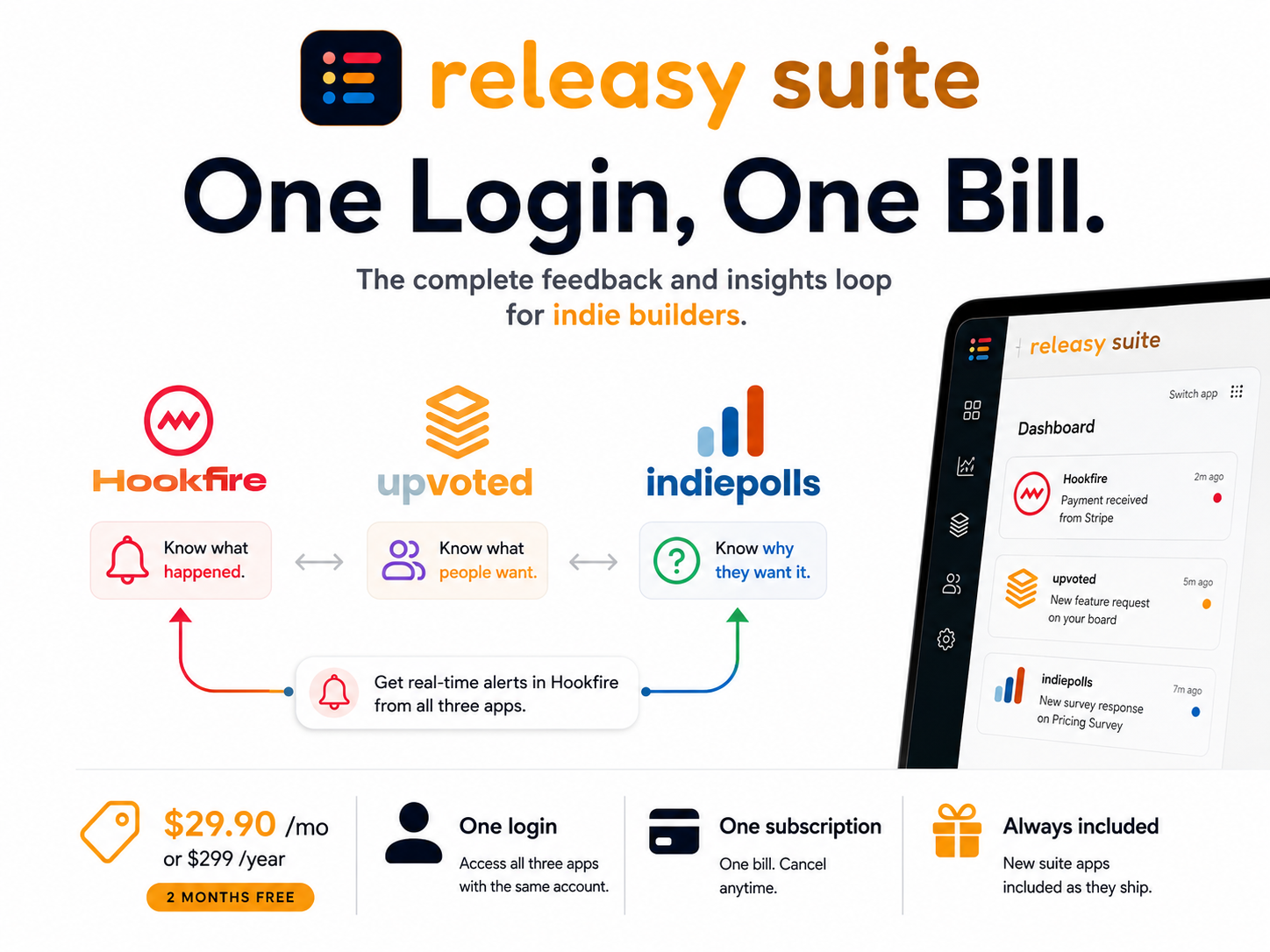
Votes tell you what is popular, not why people want it. Upvoted now bundles with Indie Polls and Hookfire in one $29.90 subscription.
The most useful number on your board is also the most incomplete
A feature request with 84 votes looks like an answer. It is closer to a well-formed question.
The vote count tells you something real: this idea has more support than the one below it. That is genuinely more than most teams have, and it is why boards work. Ranked demand beats the loudest voice in the room, and it beats a roadmap built out of whoever emailed support most recently.
But sit with those 84 votes for a moment and notice what they do not contain.
They do not tell you why. Eighty four people want dark mode. Are they working at night, or do they have a light sensitivity, or did they just see it somewhere else and it felt modern? Those are three different features. One is a theme toggle, one is an accessibility commitment, and one is a redesign you probably should not do.
They do not tell you who. A vote from a trial user who churns next week and a vote from a customer on your highest plan land in the same counter, weighted identically.
They do not tell you when. A board is a place you visit. If a request goes from twelve votes to ninety in an afternoon because someone posted about you, you find out the next time you happen to open the tab.
None of that is a flaw in voting. It is just the edge of what a vote can carry. Voting is a prioritization instrument. Asked to do research and to do monitoring as well, it does neither.
Three instruments, one loop
Upvoted is now part of the Releasy Suite, alongside two products built for exactly the gaps above.
Indie Polls handles the why. It is a survey tool: describe what you want to learn, and AI drafts the questions for you. You embed it as a lightweight widget on any page, or share it as a hosted link, and you can target it by URL, path, or domain. That targeting is what makes it useful next to a board. The people who voted for dark mode are a known group, and asking them one focused question is far more informative than the comment thread they did not write in.
Hookfire handles the when. It turns webhooks into push notifications on your phone, from more than thirty sources including Stripe, GitHub, Sentry, Intercom, and Zendesk. Upvoted itself is one of those sources. A new feature request or a burst of votes on your board arrives on your lock screen in the same stream as your payments and your errors, so movement finds you rather than waiting for you.
Upvoted’s three pillars have always been capture, prioritize, and communicate. The suite extends the same line: capture the request, prioritize by votes, then validate with a survey and notice the moment it moves.
What this looks like on a real request
Take the dark mode example through all three.
Someone posts it on your public board and it collects votes. Hookfire pings you when it crosses whatever threshold you care about, so you are looking at it while it is hot rather than at the end of the quarter.
You want to know what is actually being asked for, so you publish a short Indie Polls survey targeted at the pages those users spend time on. Three questions. Is it eye strain, or preference, or something else. Would a system setting that follows the OS be enough. Would you use it daily or occasionally.
Sixty replies later you know that most of them work in the evening and would be satisfied by an automatic OS-matching setting. That is a much smaller build than the full theming system you were quietly dreading, and you now have evidence for the scope cut rather than a hunch.
You move the feature through your board statuses, from proposed to shipped. Everyone who voted gets notified, because that was already how Upvoted worked.
The difference between that sequence and the usual one is not effort. It is that you stopped guessing at the step where guessing costs the most: deciding what the request actually means.
How the bundle works
One subscription covers all three products.
One login. Buy the suite in any of the three apps and the other two unlock for the same email address. There is no second registration and no new password. Each app has a switcher in the header, a small grid icon, and clicking through signs you in on the other side.
One bill. A single monthly charge instead of three separate subscriptions, three invoices, and three renewal dates you have to keep track of.
Every app unlocked. The full top tier of each product, not a limited trial version. Unlimited boards, unlimited integrations, unlimited surveys. New suite apps are included as they ship.
Worth being precise about one thing: each product keeps its own account and its own data. There is no shared workspace or team roster across all three, so your Upvoted collaborators are your Upvoted collaborators. What travels between the apps is your identity and your subscription.
Pricing
The Releasy Suite is $29.90 a month, or $299 a year, which is two months free.
Each product’s top tier costs $14.90 a month on its own. Three of them is $44.70. The bundle is less than the price of two.
Every plan starts with a 7 day free trial with no credit card required. If it is not useful, cancel in a click.
If you are already using Upvoted
Nothing about your boards changes. Your features, votes, comments, statuses, and integrations all work exactly as they did.
What is new is the switcher in your header. Open it and you can look at Indie Polls and Hookfire without creating anything. If you want to try the pattern above, start with a single survey aimed at your top-voted request. One question, asked of the right people, tends to change a roadmap more than another fifty votes will.
Stop guessing. Start listening, then check what you heard.
 Steve Means
Company
Product
Legal
Other apps from Releasy
Indie friendly lightning fast polling you can embed anywhere or share with one click. Generate polls with AI in seconds, get detailed stats, and configure everything in seconds.

The headless API first Issue Tracker. Report issues from anywhere, share them with anyone. Supabugs is the fastest and simplest platform to report, track, and resolve issues.

Connect Stripe, Shopify, PayPal, GitHub and 10+ other platforms. Get instant push notifications on your phone when payments land, orders ship, or subscriptions cancel.

A text RPG of private descents. AI generates a fresh dungeon in real time every playthrough, shaped by your choices and never repeated.
Try Releasy, the hassle-free test management platform and issue tracker for agile teams. Releasy allows your clients, even those without a technical background to test, validate, and accept project releases with ease.