

How to Build a Public Product Roadmap (Without Overwhelming Your Team)
PublicProductRoadmap.png
Your customers want to know what you're building. Your support team is tired of answering "when will you add X?" for the hundredth time. And your product team needs a better way to figure out what actually matters.
A public product roadmap solves all three problems. But most teams avoid it because they think it means more work, endless commitments, and angry customers when timelines slip.
It doesn’t have to be that way.
Why bother with a public roadmap?
It builds trust. When customers can see what you’re working on, they stop feeling like they’re shouting into the void. Even if their feature isn’t next, knowing it’s on your radar changes the whole dynamic.
It cuts down support noise. Instead of explaining your plans over and over in emails and chat, you point people to one place. Your team gets hours back every week.
It helps you prioritize better. When customers can vote on what matters most to them, you’re making decisions based on real demand instead of whoever yelled loudest in your last customer call.
Where teams usually mess up
The biggest mistake is treating a roadmap like a promise. You put dates on everything, ship two things late, and now everyone’s upset. Dates are the enemy of a healthy public roadmap.
Another trap: updating it manually. If you’re copying things from Jira into a Notion doc that you then screenshot for your website, you’ll abandon it in three months. It has to be easy or it won’t happen.
And finally, going one way. You share what you’re building but never close the loop. Customers submit ideas and hear nothing back. That’s worse than having no roadmap at all.
A simple framework that actually works
Step one: Make it easy to collect requests. You need feedback coming from everywhere your customers already are. That means an embedded widget on your site, a form in your app, email integration, whatever gets ideas out of people’s heads and into one place.
Step two: Let customers vote. Don’t guess what matters. When people can upvote the features they care about, you see patterns. Twenty votes on one feature and two votes on another? That’s your answer right there.
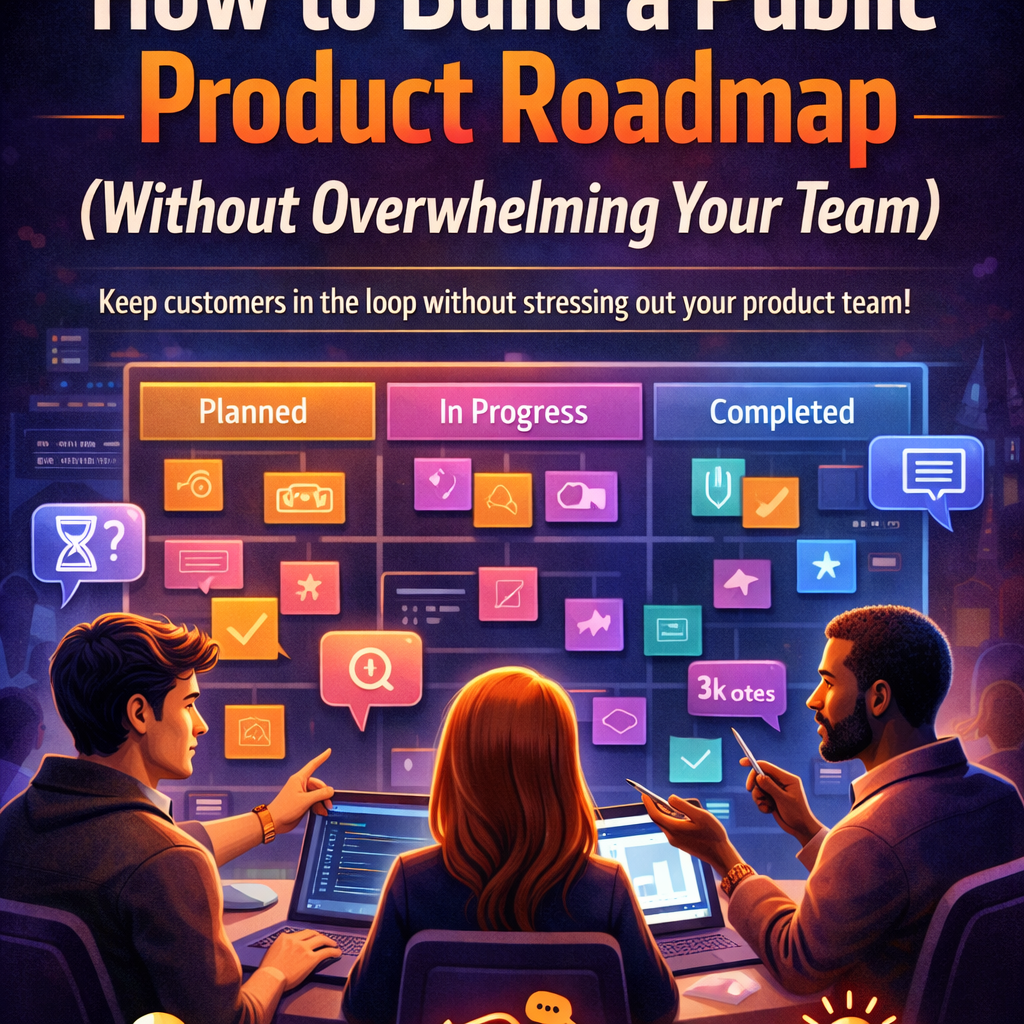
Step three: Use statuses, not dates. Instead of “shipping March 15th,” use stages like Under Review, Planned, In Progress, Shipped. Customers get context without you making promises you can’t keep. When timelines slip (and they will), nobody’s mad because you never committed to a specific date.
Step four: Actually update it. This is where automation saves you. Connect your roadmap to Slack so your team sees new requests without checking another tool. Use Zapier to sync with your project management setup. The less manual work, the more likely you’ll keep it current.
Step five: Close the loop. When you ship something, announce it. Tag all the related requests as “Shipped” and let everyone who voted know it’s live. This is the part most teams skip, and it’s the most important. It shows people their voice matters.
Spreadsheets vs dedicated tools vs project management software
You could do this in a spreadsheet. Some teams start there. But pretty quickly you’re dealing with version control, access permissions, formatting for public view, and manual vote counting. It’s a mess.
Project management tools like Jira or Asana aren’t built for this either. They’re great for internal planning but terrible for customer facing roadmaps. Too complex, too much internal context, and good luck getting a clean public view.
Dedicated feature request tools are built specifically for this workflow. They handle voting, status tracking, public and private views, and integrations without you having to duct tape five things together.
The embedding question
Once you’ve got your roadmap somewhere, where does it live? A separate subdomain feels disconnected. A link to another platform makes people leave your site.
The best approach is embedding it directly where customers already are. A widget in your app footer. The full board on a /roadmap page on your marketing site. It feels native, customers don’t context switch, and you control the experience.
Dark mode support matters too. If your app has dark mode and your roadmap doesn’t, it looks unfinished.
Real examples
Releasy uses an embedded widget that fits naturally into their product. Customers can submit requests without leaving the app.
Supabugs has their full roadmap embedded on their site. You can see statuses, vote on features, and browse everything they’re considering. It’s clean, simple, and clearly maintained.
Both work because they’re easy to update and integrate into existing workflows.
Start small, stay consistent
You don’t need every bell and whistle on day one. Start with one public board. Add a simple widget to your site. Connect it to Slack so your team actually sees new requests.
The key is consistency. A roadmap that’s three months out of date is worse than no roadmap. Pick a system that makes updating effortless, not another chore on your PM’s plate.
Your customers want to feel heard. Your team wants to build the right things. A public roadmap, done right, makes both happen without adding chaos to your workflow.
Ready to set up your roadmap in minutes?
Upvoted gives you everything you need to collect feedback, prioritize with voting, and share a public roadmap that stays updated automatically. Embed the widget anywhere, connect to Slack and Zapier, and let your customers see exactly what you’re building. No spreadsheets, no manual updates, no overwhelm.
Try Upvoted free and have your first board live today.
 Steve Means
Company
Product
Legal
Other apps from Releasy

Indie friendly lightning fast polling you can embed anywhere or share with one click. Generate polls with AI in seconds, get detailed stats, and configure everything in seconds.

The headless API first Issue Tracker. Report issues from anywhere, share them with anyone. Supabugs is the fastest and simplest platform to report, track, and resolve issues.

Connect Stripe, Shopify, PayPal, GitHub and 10+ other platforms. Get instant push notifications on your phone when payments land, orders ship, or subscriptions cancel.

A text RPG of private descents. AI generates a fresh dungeon in real time every playthrough, shaped by your choices and never repeated.

Try Releasy, the hassle-free test management platform and issue tracker for agile teams. Releasy allows your clients, even those without a technical background to test, validate, and accept project releases with ease.